Consider this: when you need help, have a question, or want to support a cause, what’s the first thing that you’ll do? Search online.
It’s what we all do. A parent might search for mental health services for their child. A young person might look for information about their legal rights. A donor may search for organizations addressing homelessness in their community. A prospective employee might look for mission-driven careers.
Whether they find your nonprofit depends, in part, on search engine optimization.
Search Engine Optimization is sometimes treated as a technical marketing tactic or a way to move a website higher in Google. But for nonprofits, it is much more than that. SEO can determine whether people find critical services, understand an important issue, discover a way to contribute, or even realize that support exists.
Blog Contents
- What Is SEO?
- How Search Engines Find and Evaluate Content
- The Main Components of SEO
- Why SEO Matters for Nonprofits
- How SEO Builds Momentum Over Time
- How AI Is Changing Search
- Common Nonprofit SEO Mistakes
- Free Evaluation Tools Nonprofits Can Use
- How Nonprofits Can Get Started
- SEO is Mission Infrastructure
What Is SEO?
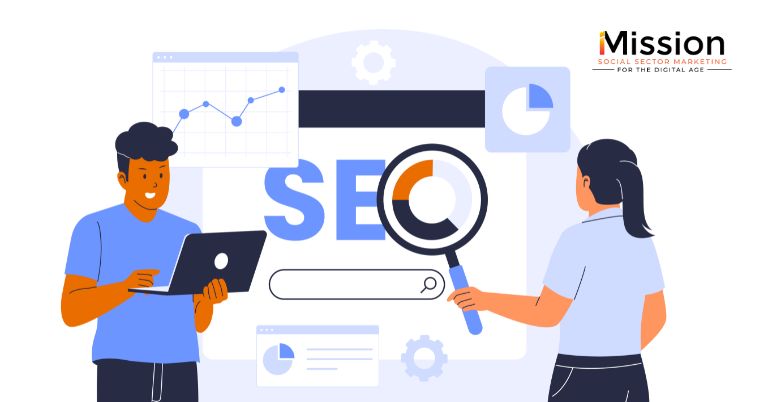
Search engine optimization, or SEO, is the process of improving a website so that search engines can understand its content and people can find it when they search for relevant information, services, resources, or opportunities.
Google describes SEO as helping search engines understand your content while helping users find your website and decide whether they should visit it.
At its core, SEO helps answer several questions:
- What does your organization do?
- Who does it serve?
- What subjects does it understand?
- What questions does its content answer?
- Why should people trust the information?
- Which pages are most relevant to a particular search?
SEO is not one action. It brings together content strategy, website structure, technical performance, audience research, accessibility, credibility, and user experience.
How Search Engines Find and Evaluate Content
Search engines use automated programs, often called crawlers, to discover pages across the internet. Those pages may then be added to a search engine’s index, where they can be considered for relevant searches.
When someone submits a search, the search engine evaluates available pages and attempts to return the results that are most useful and relevant.
Following SEO best practices does not guarantee that a page will be indexed or appear in a particular position. Google also emphasizes that there are no secret techniques that automatically produce a first-place ranking. SEO instead improves the likelihood that search engines can find, understand, and appropriately evaluate a website.
That distinction matters. SEO is not about tricking an algorithm. It is about making your organization’s value clear.
The Main Components of SEO
SEO includes several connected areas of work. A strong strategy considers all of them rather than focusing on one keyword or webpage.
Audience and Keyword Research
Keyword research identifies the words and phrases people use when looking for information.
Nonprofits often describe their services using program names, professional terminology, funding language, or acronyms. The people seeking help may use entirely different language.
An organization may offer an “extended day treatment program,” while a parent searches for:
- After-school mental health support for teenagers
- Therapy programs for children after school
- Help for a child struggling with behavior and school
- Alternatives to hospitalization for a teenager
A legal advocacy organization might use the phrase “special education discipline protections,” while a parent asks:
- Can a student with an IEP be suspended?
- What happens if my child with a disability is expelled?
- Does the school have to hold a meeting before suspending my child?
Both types of language matter. Effective SEO connects an organization’s professional expertise with the words its audiences actually use.
Keyword research should also examine search intent: what the person is trying to accomplish.
Someone searching for “signs of anxiety in teenagers” may be gathering information. A person searching for “teen therapist near me” may be ready to contact a provider. Someone searching for an organization by name may be looking for its phone number, donation page, or current programs.
Understanding that intent helps nonprofits create the right content and the right next step.
Content
Content gives search engines something meaningful to evaluate—and gives people a reason to visit the website.
SEO content includes much more than blog posts. It can include:
- Program and service pages
- Issue-area pages
- Frequently asked questions
- Resource guides
- Research and reports
- Policy explanations
- News and advocacy updates
- Staff expertise
- Impact stories
- Career pages
- Volunteer opportunities
- Donation pages
The goal is not to fit a keyword into a page as many times as possible (what we used to call “keyword stuffing”). It is to create content that fully and accurately addresses what the visitor needs.
Google’s guidance prioritizes helpful, reliable content created for people rather than content created mainly to manipulate rankings. It recommends original information, substantial coverage, firsthand expertise, and insights that go beyond what is already obvious or widely available.
For nonprofits, this is a significant advantage. Many organizations already possess deep knowledge that cannot easily be replicated by a general-purpose website.
On-Page SEO
On-page SEO helps readers and search engines understand the subject and purpose of an individual webpage.
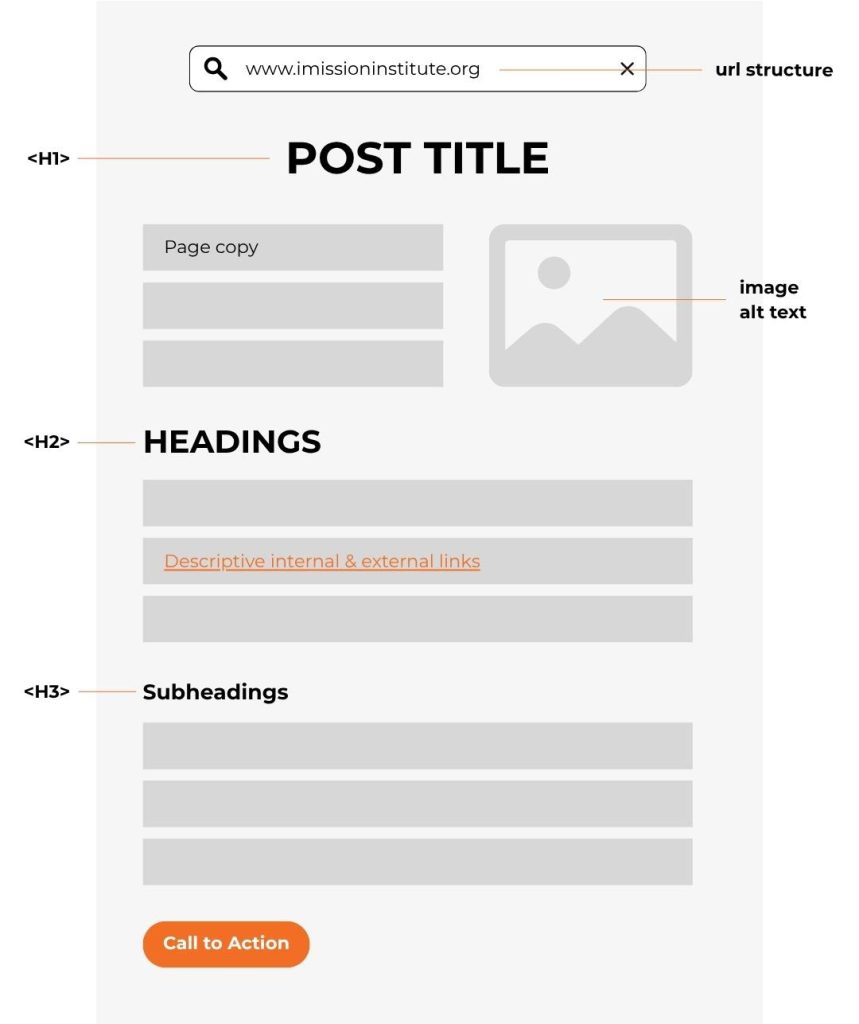
It includes:
- Page titles
- Main headings
- Subheadings
- Meta descriptions
- Page copy
- Descriptive links
- Image alternative text
- Internal links
- URL structure
- Calls to action
Consider the difference between these two page titles:
Our Services
and
Behavioral Health Services for Children and Teens in Connecticut
The second title provides much more context. A visitor can immediately see whether the page may be relevant, and a search engine has a clearer description of its content.
Clear organization is equally important. Descriptive headings, focused sections, and logical page structure make information easier to scan, understand, and navigate.
Technical SEO
Technical SEO helps ensure that a website can be accessed, crawled, processed, and used effectively.
It may include:
- Mobile usability
- Page speed
- Website security
- Crawlability
- Indexing
- XML sitemaps
- Redirects
- Duplicate-content management
- Structured data
- Clear site architecture
- Accessible development
- Working links
A nonprofit may have excellent information, but that information will struggle to reach people if the website is slow, difficult to navigate, blocked from search engines, or built in a way that prevents important content from being processed.
Google’s technical guidance recommends websites that are secure, fast, accessible, and functional across devices.
Off-Page SEO and External Authority
Search engines also consider how a website fits into the broader online ecosystem.
Links and references to your website from other credible websites can help demonstrate that people and organizations value the content. These may come from:
- Community partners
- Government agencies
- News organizations
- Professional associations
- Funders
- Research institutions
- Schools and universities
- Other respected nonprofits
These links should be earned through meaningful work and useful resources—not purchased or generated through spammy link-building schemes.
Offline credibility can also create online authority. A nonprofit that publishes original research, offers expert testimony, develops community partnerships, or contributes to public policy may naturally earn media coverage and links from other organizations.
Local SEO
For nonprofits serving a particular geographic area, local SEO helps people find nearby services, facilities, events, and opportunities.
It includes maintaining accurate information such as:
- Organization name
- Address
- Phone number
- Service area
- Office hours
- Program locations
- Website links
Google Business Profiles, online directories, maps, location pages, and locally relevant website content can all support visibility.
Local SEO is especially important when someone searches for phrases such as:
- Homelessness services near me
- Youth programs in New Haven
- Veterans housing support in Connecticut
- Volunteer opportunities in Hartford
- Children’s counseling near me
Why SEO Matters for Nonprofits
SEO is often evaluated through traffic, impressions, and rankings. Those metrics are technically useful, but they do not fully capture SEO’s value to a nonprofit.
For a mission-driven organization, SEO is fundamentally about access and connection.
It Helps People Find Services
People do not always know which organization they need. They may not know the formal name of a service or understand how the nonprofit sector describes their situation.
They simply know what problem they are facing.
A strong search strategy helps your organization appear during that critical moment of need.
It Extends Educational and Advocacy Work
Nonprofits often work to change public understanding, not just deliver programs.
Search-optimized resources can help an organization explain:
- A complicated policy
- A community challenge
- A person’s legal rights
- The causes of an issue
- The impact of proposed legislation
- What meaningful solutions look like
That information can continue reaching people long after a social media post has disappeared from a feed or a news story has passed.
It Supports Fundraising, Recruitment, and Engagement
People also search for ways to act.
They may look for:
- Nonprofits to support
- Organizations addressing a particular issue
- Volunteer opportunities
- Nonprofit jobs
- Community events
- Corporate partnership opportunities
- Research and subject-matter experts
SEO can strengthen every part of a nonprofit’s audience journey—not just program outreach.
It Creates Sustainable Visibility
Paid advertising can generate immediate exposure, but that exposure generally ends when the campaign budget ends.
A useful service page, resource guide, or policy explanation can continue appearing in search for months or years. It may require updates, but the initial investment can keep producing value over time.
SEO is not free. It requires strategy, staff knowledge, writing, development, measurement, and maintenance. However, the visibility it creates is not tied to paying for every click.
How SEO Builds Momentum Over Time
One strong article can reach people. A connected library of strong content can establish an organization as a trusted resource.
When a nonprofit consistently publishes useful content around its core areas of expertise, search engines gain more context about what the organization knows. More pages may begin appearing for relevant searches. Helpful resources may earn links and references. Visitors may explore related content or return to the website when they have another question.
This can create a compounding cycle:
Useful content builds relevance and credibility. Greater relevance can improve visibility. Increased visibility can lead to more engagement, links, references, and recognition. Those signals can further strengthen the website’s overall search presence.
This process is sometimes loosely described as building “domain authority,” although authority is more complicated than one score or ranking factor. The strongest strategy is not simply publishing more. It is creating a focused, interconnected body of high-quality content around the subjects the organization genuinely understands.
How AI Is Changing Search
Search is no longer limited to a page of traditional links.
People are increasingly receiving direct, synthesized responses through Google’s AI features, ChatGPT search, Microsoft Copilot, and other generative platforms. These tools may retrieve information from multiple websites and cite sources within the resulting answer.
This has led to new terms, including answer engine optimization (AEO) and generative engine optimization (GEO).
However, the fundamentals stay the same. Google states that its generative search features remain rooted in its existing search ranking and quality systems. Crawlable websites, useful information, clear technical structure, and credible content still form the foundation.
Common Nonprofit SEO Mistakes
Several recurring problems can limit a nonprofit’s visibility.
Writing Only About the Organization
News, awards, events, and internal updates have value. But they may not answer the questions prospective clients, supporters, or partners are entering into search.
A balanced content strategy should address both organizational news and audience needs.
Using Internal Language
Program names and professional terminology may not match the words people use when asking for help.
Nonprofits should retain accurate sector language while also explaining it in plain terms.
Creating Disconnected Blog Posts
Publishing articles about unrelated subjects may generate activity without building meaningful authority.
Content should support defined mission areas, audience needs, services, or organizational goals.
Neglecting Core Pages
A nonprofit should not publish dozens of articles while leaving its primary program pages vague, outdated, or difficult to navigate.
Core service, issue, location, donation, and engagement pages should be the foundation.
Publishing Generic Content
A broad article that repeats widely available information may offer little reason for readers—or search engines—to prefer it.
The strongest nonprofit content includes original expertise, community context, examples, data, experience, or practical guidance.
Expecting Immediate Results
SEO generally takes time.
Google notes that some changes may appear within hours, while others can take several months. It recommends allowing at least several weeks before evaluating whether a change had a meaningful effect.
SEO should be measured over time, not judged by the performance of one page after a few days.
Free Evaluation Tools Nonprofits Can Use
No single tool can provide a definitive assessment of a website’s overall SEO. A fast website may still contain weak content, while a well-written page may still be difficult for search engines to crawl or index. Using several tools together can provide a more complete picture.
Website Performance
Google PageSpeed Insights evaluates the performance of an individual webpage on mobile and desktop devices. It can identify issues affecting loading speed, responsiveness, and the overall user experience.
Crawling, Indexing, and Search Performance
Google Search Console helps verified website owners understand how Google accesses and indexes their websites. Nonprofits can use it to identify indexing problems, inspect individual URLs, see which searches bring people to the site, and monitor clicks and impressions.
Bing Webmaster Tools provides similar search-performance data, along with a site-scanning tool that can identify common technical SEO problems.
Content and On-Page SEO
For nonprofits with WordPress websites, Yoast SEO offers free, real-time guidance while creating or editing pages and blog posts. Its SEO analysis reviews elements such as focus-keyphrase use, page titles, URLs, meta descriptions, internal and external links, and content structure. Its readability analysis also identifies issues such as long sentences, passive voice, limited use of transition words, and difficult-to-read copy.
Yoast can be particularly helpful for nonprofit staff who manage website content but do not have extensive SEO experience. It places practical recommendations directly within the WordPress editor, making basic optimization part of the publishing process.
However, Yoast’s red, orange, and green indicators should be treated as guidance—not as a guarantee that a page will rank well. A page can receive a green score and still be too generic, target the wrong search intent, or lack the expertise and authority needed to perform. Likewise, a strong page does not need to satisfy every automated recommendation. Yoast also provides a free online SEO Checker that can review an individual public webpage for content, formatting, technical, and linking issues, even when the website does not use WordPress.
SEO tools can identify problems—but they do not always tell you what to prioritize.
iMission helps nonprofits evaluate their websites, understand their search opportunities, and turn technical findings into a practical SEO roadmap. Our work may include keyword research, website and content audits, on-page optimization, technical recommendations, and ongoing performance analysis.
Talk with iMission about your nonprofit’s search visibility.
How Nonprofits Can Get Started
A practical SEO strategy can begin with a few core steps:
- Identify the audiences your organization most needs to reach.
- Brainstorm the questions those audiences ask.
- Review whether your website clearly answers those questions.
- Strengthen core program, service, and issue-area pages.
- Select several priority subject areas for ongoing content.
- Improve page titles, headings, internal links, and calls to action.
- Address major mobile, speed, accessibility, and indexing problems.
- Configure Google Search Console and Bing Webmaster Tools.
- Publish useful content consistently.
- Review performance and update the strategy based on what people are searching for.
The goal is not to complete SEO once. It is to build search considerations into the way the organization plans, creates, publishes, and maintains its website.
SEO is Mission Infrastructure
A nonprofit website should do more than confirm that the organization exists.
It should help people find support, understand issues, trust the organization’s expertise, and take meaningful action.
SEO makes that possible by connecting the organization’s knowledge with the people actively looking for it.
That makes SEO more than a marketing tactic. It is part of the infrastructure that helps a nonprofit carry out its mission online.
iMission helps nonprofits improve search visibility through SEO strategy, keyword research, website optimization, content development, technical guidance, and ongoing analysis. Whether your organization is rebuilding its website or strengthening an existing one, we can help you create a practical strategy focused on the audiences and outcomes that matter most.
Ready to make your nonprofit easier to find? Contact iMission to start the conversation.